I never thought I’d take a taxi on the Camino.
When I walked my first Camino, I believed that if you walked the Camino, you walked every mile, climbed every hill, and earned every blister. In my mind, that was simply what pilgrims did. Anything less somehow didn’t count.
Life, of course, had other plans.
I’ve always been someone who could endure. I never really had a choice. I also enjoy a challenge. Tell me I can’t do something, and I’ll probably try to prove you wrong.
In 2019, I found out I had a pituitary tumor. An adenoma.
Suddenly, so many things made sense. I hadn’t been feeling like myself for quite some time, but I had done what I had always done. I kept going. I blamed stress. I told myself I just needed a vacation.
After my MRI, I found myself sitting in the office of a neurosurgeon in Boston. He was in his eighties and one of the country’s leading pituitary specialists. This was all he did.
When it came time to schedule my surgery, he reached into the pocket of his white coat and pulled out a small, well-worn paper datebook. No computer. No online scheduler. Just a pocket calendar and a pen. Here was one of the world’s leading pituitary surgeons, scheduling brain surgery the same way he’d probably done it for decades. Somehow, that made me trust him.
We scheduled my surgery shortly after he returned from a trip to Europe.
I’ll never forget seeing him in pre-op. The first thing I asked was whether he was jet-lagged. I told him I’d be happy to reschedule if he was tired.
He smiled and assured me he was ready. My surgery lasted about six hours.
Recovery, however, was just beginning. I was exhausted, struggled with brain fog, and spent months taking steroids while we waited to see whether my pituitary gland would recover.
When a follow-up MRI revealed an infection at the surgical site, it meant more appointments, more uncertainty, and the possibility of another surgery. Then, just as I was trying to find my footing again, the world shut down.
I felt like I was on a hamster wheel. I was going around and around but getting no answers. My doctors encouraged me to push myself physically, and I had taken a leave of absence from work with only a few weeks left before I needed to return.
So, I thought, If I need to push myself, I’ll walk another Camino.
At the time, it made perfect sense.
It was September 2021, and I had chosen the Camino Primitivo, the original and most mountainous Camino.
I hadn’t trained because I couldn’t. My body was still recovering.
The Camino humbled me almost immediately. On the very first day, I developed blisters on the balls of both feet.
Over the course of that Camino, I took three taxis. Each one challenged the story I had always told myself about strength.
One because my body simply couldn’t go any farther.
One during a thunderstorm that tested one of my biggest fears.
The third came on the morning we crossed the Hospitales Route. The evening before, our host suggested we take a taxi a few kilometers up the road. She explained that the first section wasn’t particularly scenic and that it would shorten what was already one of the most demanding days on the Camino.
I wrestled with the idea.
Eventually, I agreed.
The next morning, we had breakfast, climbed into the taxi, and were dropped off at the beginning of the climb. The sun was just beginning to rise over the mountains.
I reached into my pocket for my phone to take a picture.
It wasn’t there.
My heart sank.
My phone wasn’t just a camera. It held my reservations, my way of communicating with family, my identification, and the credit cards tucked inside the wallet attached to it.
Using another traveler’s phone, I called the place where we had stayed the night before.
My Spanish was still pretty limited. The man who answered hung up on me. I called again. And again…
Finally, someone understood and told me to wait.
Standing there on the side of the road, waiting for the taxi to return, I couldn’t help but wonder if the Camino was trying to teach me something. Had I taken the easy way out?
A little while later, the taxi driver returned. He had found my phone in the back seat. He smiled, handed it to me, and apologized, as though somehow it had been his fault.
Standing there with my phone safely back in my hands, I couldn’t help but laugh.
By then, we probably could have walked those five kilometers.
Looking back now, I don’t think the lesson had anything to do with the taxi.
That Camino taught me about grace, not only the grace we extend to others, but the grace we so often forget to extend to ourselves.
For much of my life, I measured strength by what I could endure. I believed strength meant pushing through, working harder, and never asking for help.
But my body wasn’t failing me.
It was healing.
As I walked the Primitivo, I realized every pilgrim was carrying something. Some carried grief. Others carried illness or were recovering from injuries. Some walked with broken hearts, while others carried burdens no one else could see.
We never really know what someone else is carrying.
Sometimes we forget that we’re carrying something, too.
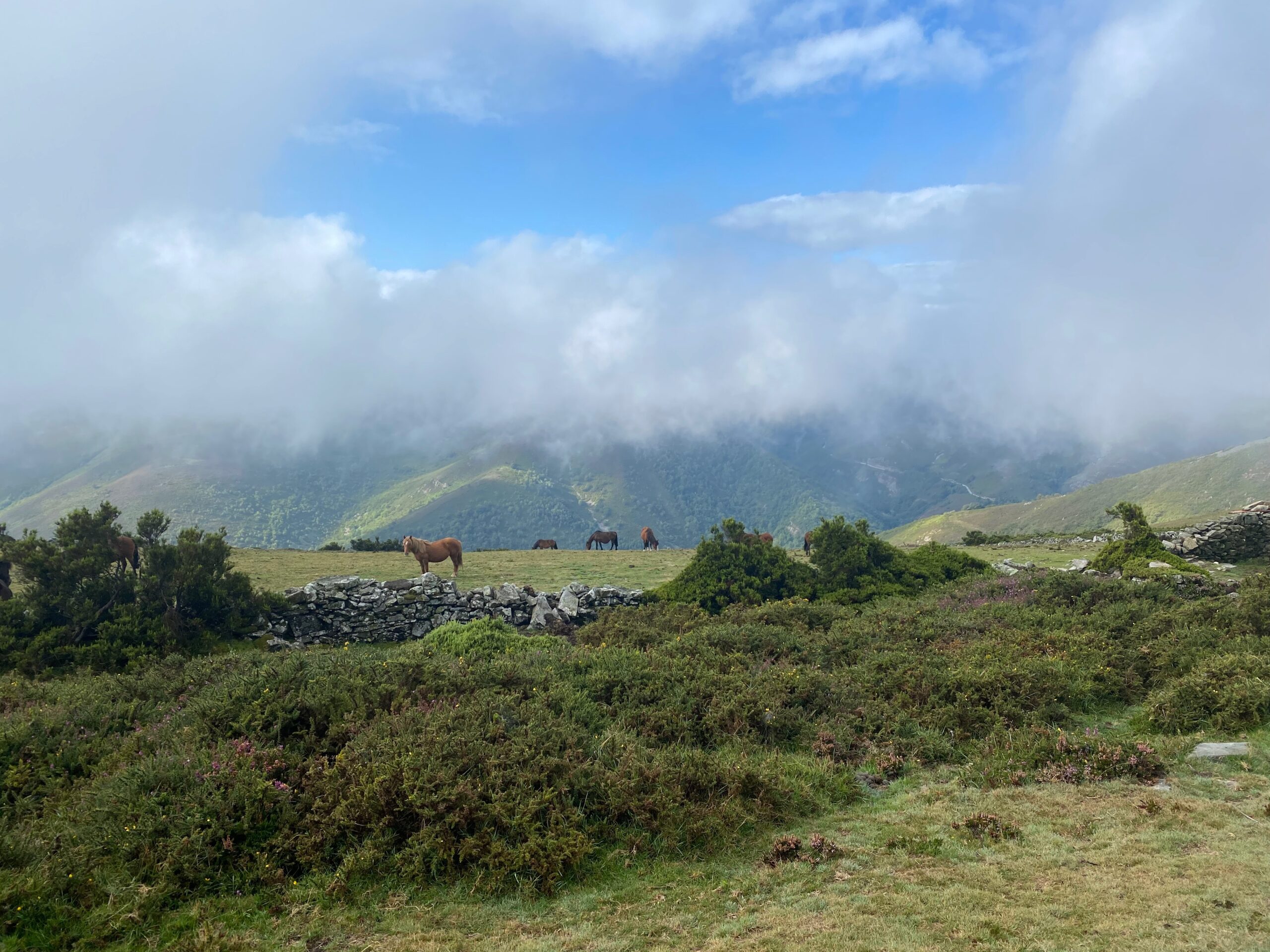
The Hospitales Route was everything people had promised it would be. Mountain ridges disappeared into the clouds. Cowbells echoed across the valleys. Wildflowers danced in the wind, and mist rolled over ancient paths. It remains one of the most beautiful days I’ve ever experienced on the Camino.
Not because it was easy.
Because it changed the way I thought about strength.
I’ve walked many Caminos since then, and no two have been exactly the same because neither have I.
Looking back, I don’t remember those taxi rides with embarrassment. I remember them with gratitude. They remind me that strength isn’t always found in pushing harder. Sometimes it’s found in accepting the ride that allows you to keep walking.
